
The Beginner's Guide to Choosing Violin Strings: Everything You Need to Know
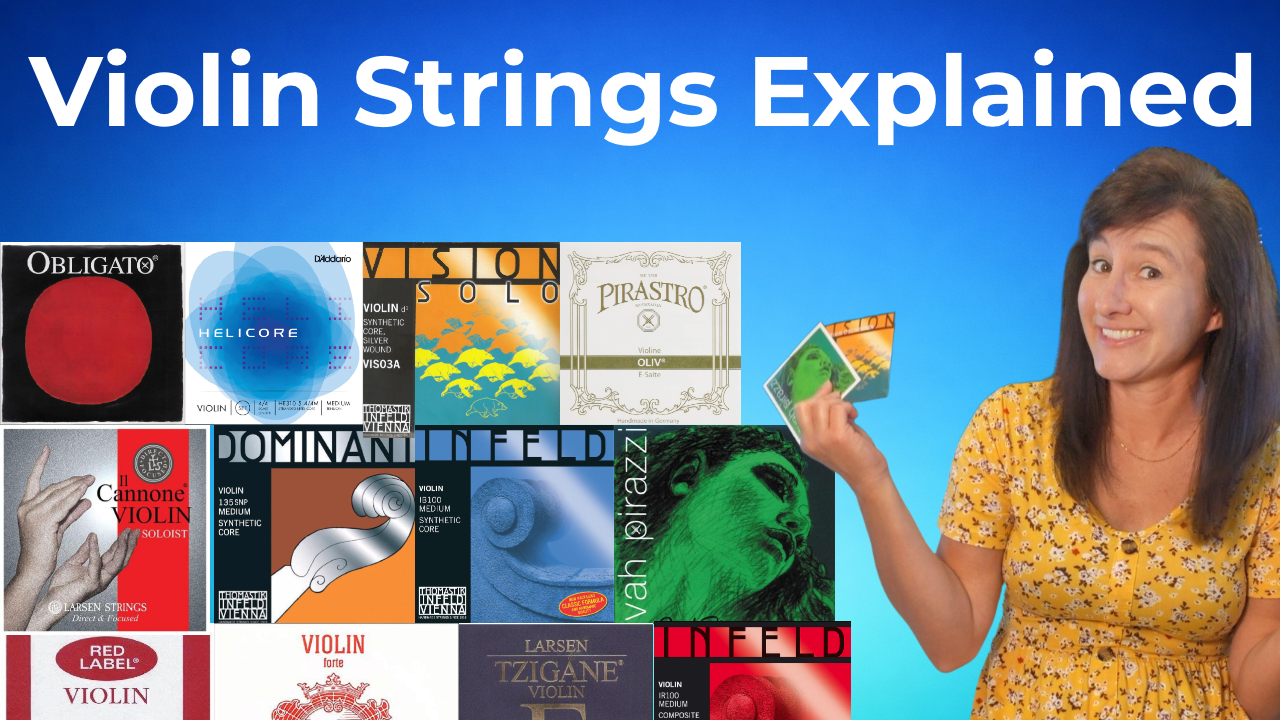
/If you’re wondering “how to choose violin strings,” you’re not alone! Trying to decide which violins strings are right for your instrument can be an overwhelming decision considering how many options there are for violin strings these days. There are so many variables when it comes to choosing strings—brands, tensions, core materials— it can get confusing quickly. But f you're wondering how to choose violin strings that will help you sound your best, you're in the right place!
Today I’m going to tell you exactly how to purchase violin strings and what decisions you need to make to ensure you have the best set of strings for your instrument! First off, let’s talk about a couple of common questions when it comes to changing your violin strings.
When to Change Violin Strings: How Often Is Necessary?
A common question for students is "how often should you change violin strings?" While there isn't a hard expiration date, here are some general guidelines:
New Violins and New Players: If you just bought your first instrument, you probably don't need to worry about restringing a violin for the first year—unless you have very cheap, factory-grade strings. If you’re playing a lot (like 7+ hours a week every week, then you may want to change those strings sooner).
The 6-12 Month Rule: For most active students, changing your strings every 6 to 10 months is ideal to maintain a brilliant tone.
Signs of Wear: If your violin sounds dull or you're getting frustrated because you "don't sound good," it’s likely your strings have lost their resonance and it’s time for a string change!
Quick Recommendations for Choosing Violin Strings
Keep reading to learn all about violin string tension, gauge, loop or ball end E, and more. But, if you just want my basic recommendations, here ya go!
A Good Place to Start
A little brilliance like Evahs, a little warmth like Obligatos, all at a fraction of the cost make Visions a good option.
Bright, Responsive, Projecting

Powerful, bright, sweet with rich, complex overtones. A favorite of many professionals.
Broad and Warm
Great for Fiddling (More Affordable)
Helicores are a good option if you want a decent string at an affordable price. They’re also a favorite of fiddlers!
Obligatos have a very rich, dark, warm sound, perfect for toning down bright instruments.
I’ve got lots of more options so keep reading if you want more violin string choices!
How to Choose Violin Strings: The Technical Basics
Before you look at violin string brands, you need to ensure you have these three technical specs covered:
1. Size: Match your strings to your violin (e.g., 4/4 full size, 3/4, or 1/2).
2. Ball-End vs. Loop-End E Strings: Look at your tailpiece. If the E string hooks onto a tiny post, you need a Loop-End. If it sits ends in a ball that fits in a slot, you need a Ball-End.(Some brands only come with removable ball end E strings that work for both loop and ball end E strings.
3. String Gauge & Tension: Most beginners should stick with Medium Tension strings. Heavy gauge strings offer more power but can feel stiff, while light gauge strings respond quickly but have less volume.
4. Make sure they’re actually violin strings! It can be easy to accidentally order viola strings, so double check and make sure they say “violin strings".”
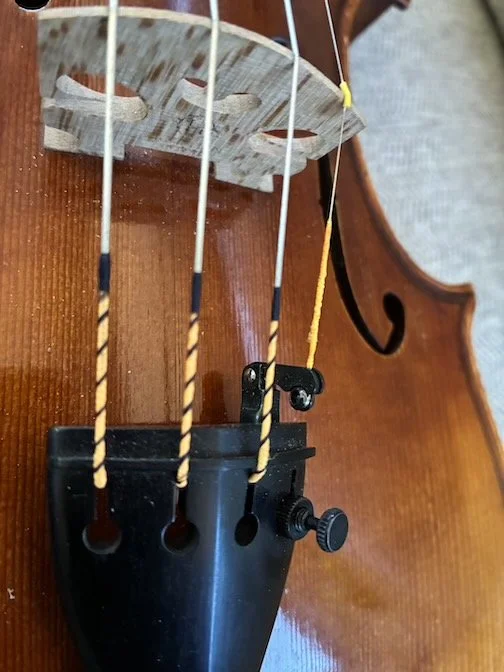
This tailpiece requires a ball end E string
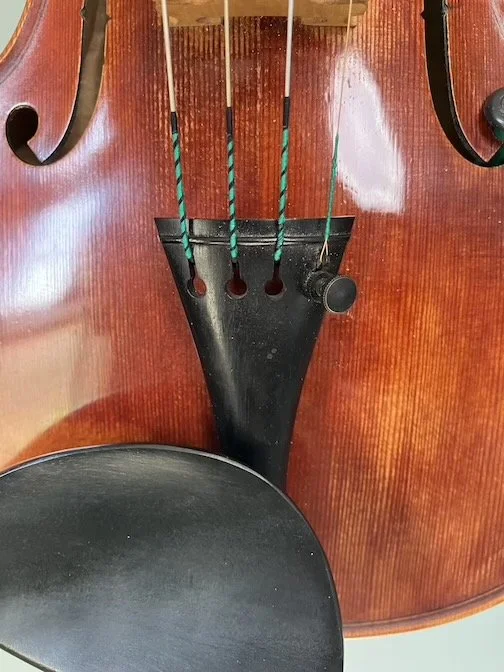
This tailpiece requires a loop end E string.
Synthetic vs. Steel Core Violin Strings
A major part of choosing strings is understanding the core material.
Steel Core Strings: Often the most affordable violin strings, like the popular D’Addario Prelude or Red Label brand. They are durable and bright but can lack tonal depth. (I don't recommend these types of strings unless you are on a tight budget or you really want that bright type of sound for something like Old Time fiddling, bluegrass, or country music).
Synthetic Core Strings (Recommended): These are made of various synthetic materials. They offer the warm, rich sound of traditional gut strings with the stability of steel. These are the violin strings I typically recommend for most people.
Are Gut Violin Strings Good To Use?
Violin Strings have been traditional made of gut for hundreds of years. However, gut strings have quite a few cons that don’t make them very practical.
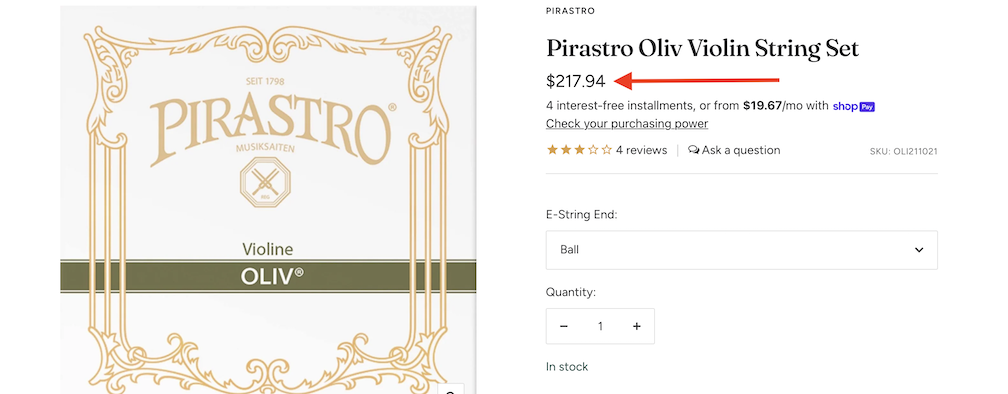
Eek! The ain’t Cheap.
Gut violin strings are very expensive. I mean really expensive. Like two or three times the price of a good synthetic string.
Gut violin strings loose their resonance very quickly. A synthetic string will last you 5-8 months of quality sound, and even after that, they don’t necessarily sound just horrible. Gut strings on the other hand will loose their resonance much sooner (maybe around 3 months give or take). And when gut strings are dead, they are dead. You can’t squeeze a few more months of use out of them.
My recommendation is to go with synthetic core strings unless you’re doing period performances and just really want to be historical accurate.
What is violin string tension and why is it important?
I’m going to be honest here. I really did not understand violin string tension until recently. I don’t ever recall my professors talking about it or my peers discussing this string brands tension over that string brands tension. As you’ll often hear with most professionals, our teacher recommended a string brand when we were in high school. It sounded good on our fiddles so we never tried anything else (and never asked the questions about tension). The more I try different brands, the more I realize how important string tension is. So what is violin string tension?
String tension is the force required to stretch a string to a desired pitch. You may think, all A strings no matter the brand would have the same tension since we’re stretching that string to an A, but that’s not quite the case. Since strings are made of various materials, they have different tensions.
The string gauge or thickness will also affect the tension. Heavy gauge strings will have higher tensions (since it takes more force to stretch them to that desired pitch) and lighter gauge strings will have lower tensions.
A specific string brand often comes in 3 options for string tension/guage: heavy, medium, and light. So you could buy Evah Pirazzi Green violin strings, but then you have 3 options for gauge. I usually recommend always starting with medium.
But each brand of violin string will have various tensions as well. For instance, a medium gauge Dominant string will have lower over all tension than a medium gauge Evah Pirazzi string.
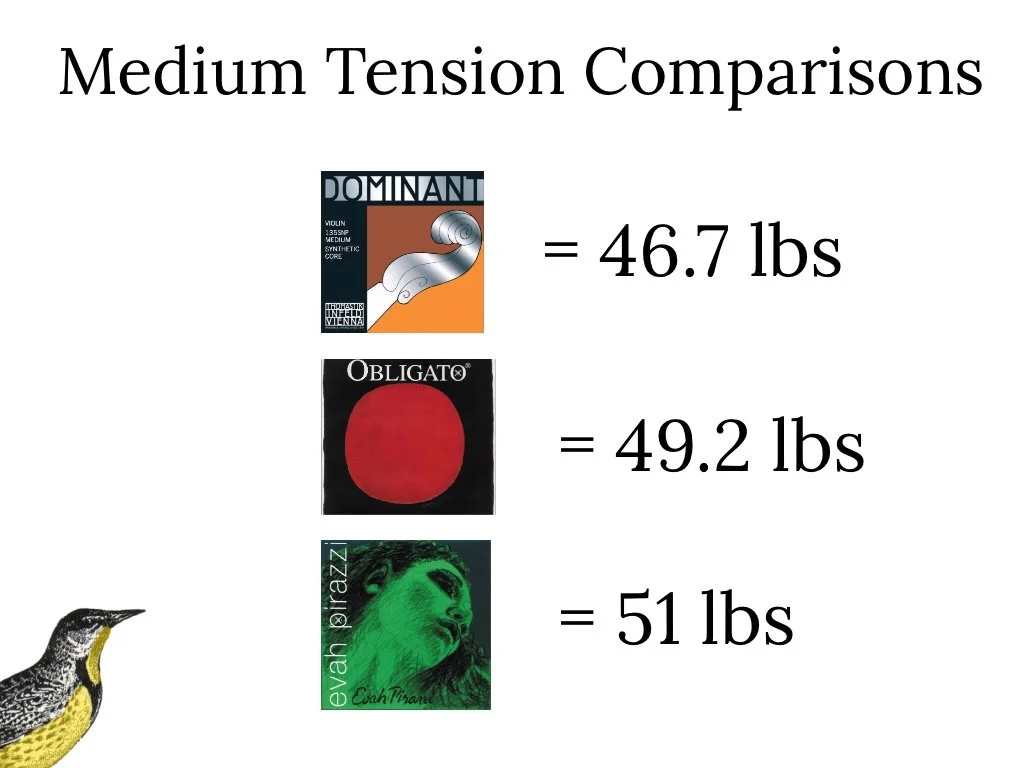
So why is this important for you? Well, higher tension brands might be perfect for your violin, but on the other hand, it might choke your sound and kill all the overtones. Here’s a brief summation of the pros and cons of higher and lower tension strings.
Higher Tension: more projection, body, and power. More resistance to the bow. More resistance to the fingers. Performers and soloists tend to love these for their projection.
Lighter Tension: Less projection. More broad sounding. Less resistance to the bow. Feels softer under the fingers.
This is something that took me a while to understand. I used Evah Pirazzi Green (relatively high tension strings) on my first two violins with no problems. It sounded great! Then when I bought Meriwether, I slapped some Evahs on there and whoh, he didn’t like those!
So if you’re trying out string brands for your violin, my recommendation is to start with lower tensions and work your way up from there.
Of course, you can always try higher tension strings, there’s really no harm in trying them. Just be prepared if you find they are way too high and you want to change them out quickly, you won’t get the full value out of the strings. But hey, you may also put on lower tension strings and not like the way they sound either.
The bottom line, picking the right set of strings has a lot of trial and error involved. And those trials aren’t cheap at $50+ a pop for a set. But finding that perfect string that just makes your violin sing is worth it!
Check out Violin String Reviews Tension Guide for more information on each specific string brands’ tension.
Picking Violin Strings For Certain Tonal Qualities
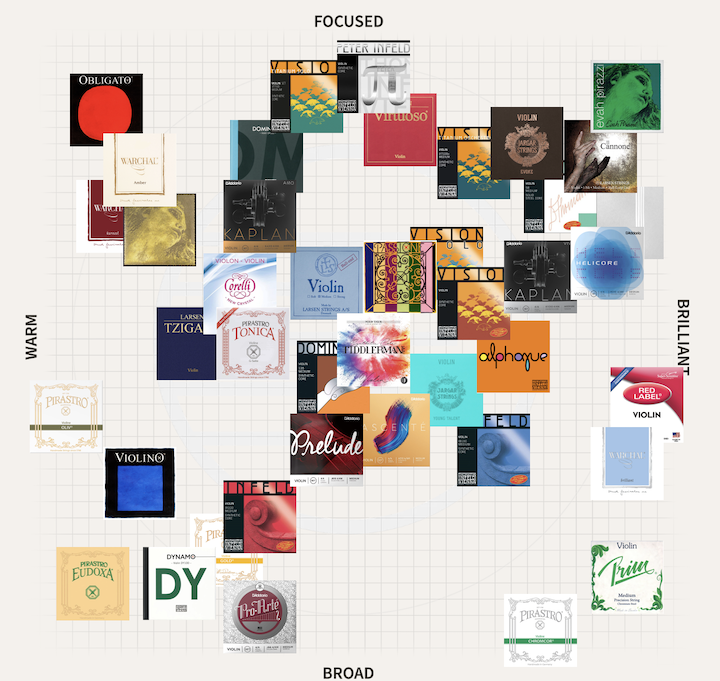
Violin strings can make a big difference when it comes to the tonal qualities of your violin. Some violin strings can bring out certain qualities or downplay other qualities. If your violin is really bright, you may want a warmer string to balance it out. For instance, Meriwether is a brighter instrument, so lower tension strings like Vision Titanium Orchestra work great from him. My main violin, Maria, is a darker instrument. She loves Evah Pirazzi Greens for that sweetness it brings to her rich tone. Finding the perfect match is a game (sometimes an expensive game) but fun, none the less!
This is very, very specific to your preferences and to your violin, but here is a broad overview when it comes to string qualities.
If you want a violin string that is warm, dark, rich, and usually low tension, try…
Obligatos: the standard for a warm, dark sound
Infeld Reds: brings out the warmth and darkness of a violin
If you want violin strings that are bright, focused, powerful, responsive and usually higher tensions, try…
Evah Pirazzi Greens: the standard for many professionals. Clear response and brilliant (what I use on my violins Maria and Sophia)
Vision Solos: similar to Evahs with a lot of power and projection
If you want violin strings that are more balanced.
Visions- a good balance at a good price.
Vision Titanium Orchestra. Balanced with a touch of brilliance and response (what I currently use on Meriwether which is more of a bright violin)
Evah Pirazzi Gold: On the warmer side of balanced but still has some brightness.
Infeld Blues: On the brighter side of balanced.
Dominants: and industry standard. I would call this the most balanced, middle of the road type of string. Neither too bright nor too warm. These are a great place to start and used by many violinists. Personally, I find they lack that extra “umph” and color that some of the other brands have. Dominants were the first synthetic strings on the market, and as such they were used by many famous violinists. However, there are many other great options out there nowadays that can give your violin that special something it needs.
What are good violin strings if you are on a budget?
These are also good student violin strings if you are purchasing for a child.
Ascenté: a very affordable synthetic student brand of strings
D’Addario Prelude: a standard in student steel core strings
Fiddlerman Strings: Fiddlershop’s own brand of synthetic strings. Cheaper than Dominants, better than Preludes or Asenté. A good balanced student string.
What are good strings for fiddle?
Helicores: these steel-core strings are a favorite of fiddlers and bluegrass players. They are also a great option for students who want something better than Preludes or Ascenté but don’t want to pay the price of the more expensive synthetic strings.
Final Advice for Purchasing Violin Strings: Keep it Simple
I know, I know, purchasing violin strings is overwhelming. But it’s also fun! It’s like a puzzle that only you can truly figure out the answer to. So relax, there’s lots of options, just pick one and go with it. For your first violin string change, keep it simple. Choose:

A full set
Match your violins size
Go for medium tension
Opt for synthetic strings
Choose loop end or ball end E depending on your tailpiece
(Make sure you’re actually choosing violins strings!)
Enjoy a fresh, vibrant sound!
Ready to start changing your strings? Check out my other tutorial on changing your strings here!






![10 Best Violins for Beginners: A Violin Teacher’s Ultimate Guide [2026]](https://images.squarespace-cdn.com/content/v1/554545e3e4b0325625f33fa6/1600433065588-JQV56M1W9LNI833AVGEE/10+best+violins+for+beginners+2020.jpg)